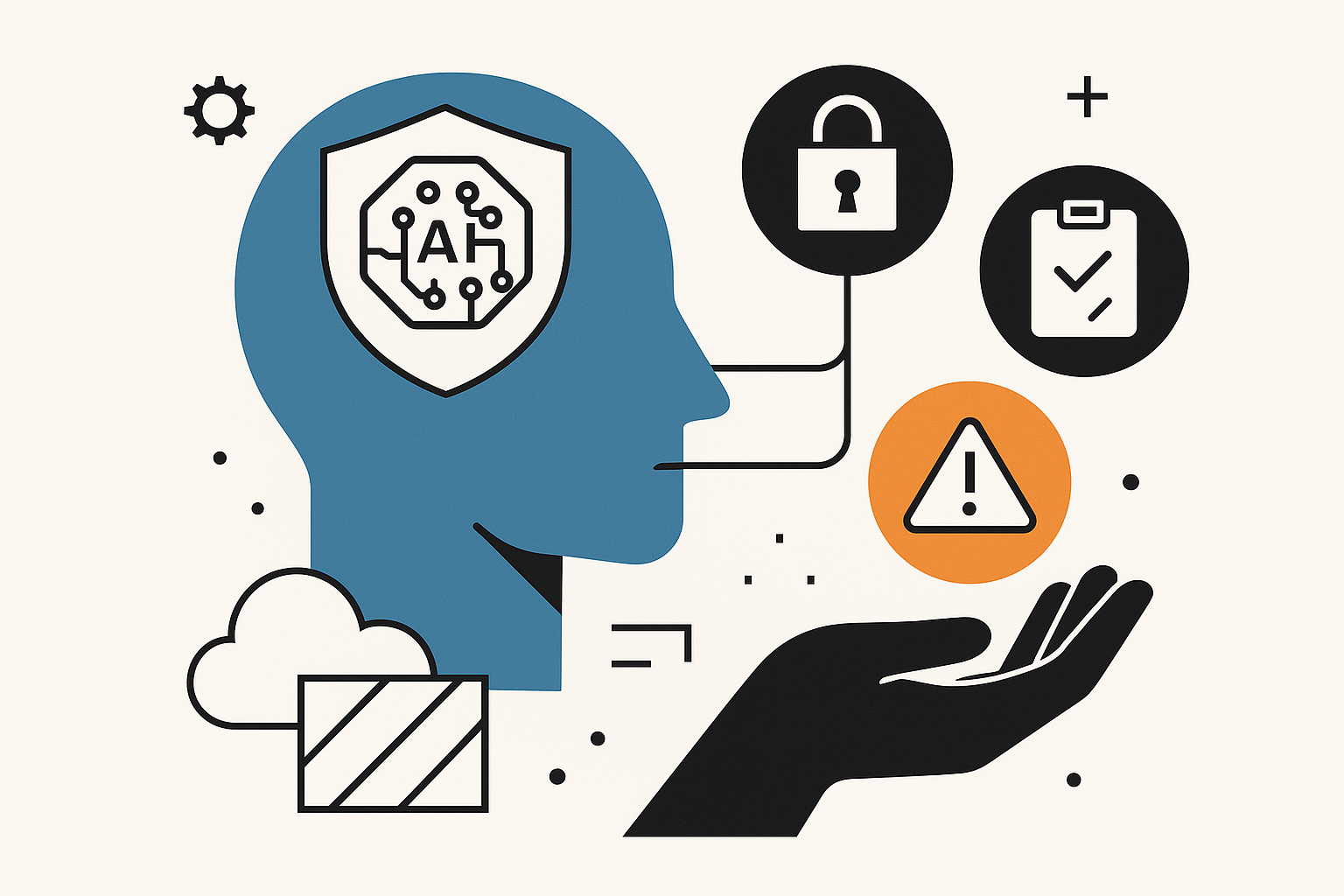
In this blog post Anthropic’s DoD stance just changed what “safe” enterprise AI means we will unpack what this moment reveals about enterprise AI risk, and why “safe” can’t be reduced to compliance checklists.
In Anthropic’s DoD stance just changed what “safe” enterprise AI means, I’m looking at a pattern I’ve seen repeatedly in large organisations: we treat safety as a feature of the model, when it’s really a property of the whole system.
Over the past 20+ years working as a Solution Architect and Enterprise Architect (and as a published author), I’ve watched “secure” gradually become measurable and operational. AI is now forcing us to do the same for “safe,” and a very public disagreement between a frontier AI vendor and a defence customer made the difference impossible to ignore.
High level, here’s the shift. For years, many leaders assumed that if a model sits in the right cloud, behind the right identity controls, and meets the right certifications, then it’s “safe enough.” What changed is that we’re now seeing safety debated as use, intent, and consequences—not just where the data is stored and who has access.
Why this matters to Australian enterprises even if you never touch defence
But the same tension shows up everywhere: a business unit wants capability, a regulator wants assurance, security wants control, and the architecture team is left to reconcile “can we” with “should we.” In Australia, that plays out under the ACSC Essential Eight, ASD guidance, and privacy expectations that are increasingly unforgiving of “we didn’t think the tool would be used that way.”
What actually changed the rules for “safe” enterprise AI
My take is that the DoD-related statement and the surrounding coverage did something subtle but important. It separated three ideas that many enterprises still bundle together:
- Security is about protecting systems and data from unauthorised access and disruption.
- Compliance is about meeting external obligations (standards, regulation, contractual terms).
- Safety is about preventing harmful outcomes, including outcomes that are “authorised,” “lawful,” or technically within policy—yet still unacceptable to your organisation and customers.
In other words, you can be secure and compliant and still deploy an AI capability that creates real harm at scale.
The core technology behind it, explained plainly
To make this concrete, let’s talk about what “enterprise AI” typically means in 2026. Most organisations aren’t training foundation models from scratch. They’re using a frontier model (like Claude or GPT-class models) through an API, and wrapping it in enterprise controls.
The architecture usually looks like this:
- A foundation model that can write, reason, summarise, and generate code.
- RAG (retrieval augmented generation) so the model can answer using your internal documents without “learning” them permanently.
- Tool use (sometimes called agents) where the model can call systems like ticketing, email, CRM, identity directories, or automation runbooks.
- Guardrails like content filters, policy checks, and safety classifiers.
- Enterprise controls like SSO, conditional access, logging, DLP, and network boundaries.
Here’s the key lesson. The “dangerous” part is rarely the model generating a dodgy paragraph. The dangerous part is the model being connected to real actions and real data, at enterprise scale, under time pressure, with ambiguous human oversight.
Why guardrails are not the same as governance
Model guardrails are helpful, but they’re not governance. Guardrails try to shape what the model says or refuses.
Governance is everything around it: who can prompt it, what data it can retrieve, what tools it can call, what it’s allowed to decide, and how you prove after the fact what happened.
Five practical lessons I’d take into any enterprise AI program
1) Define “unsafe” as business outcomes, not content categories
A lot of AI policy is still written like a social media moderation guide: hate speech, self-harm, violence, adult content. That’s necessary, but it’s not sufficient for enterprises.
In real organisations, “unsafe” often looks like:
- A model recommending an action that breaches segregation of duties.
- A support bot leaking a customer’s personal data into the wrong conversation thread.
- A security copilot suggesting a containment action that destroys evidence.
- An HR assistant inferring sensitive attributes from non-sensitive data.
Those are outcome problems. They don’t show up in a simple “block violent content” rule.
2) Treat tool access as privileged access
Once an AI system can take actions, it becomes a new kind of privileged identity. I’ve seen teams focus heavily on prompt injection, and then casually grant the agent broad API keys “because it needs to be useful.”
In my experience, that’s the moment risk spikes. Apply the same discipline you would apply to admins:
- Least privilege by default.
- Short-lived credentials.
- Explicit approval gates for high-impact actions.
- Separate “read” from “write” capabilities.
3) Build an audit trail that a human can actually follow
Many AI logs are technically detailed and practically useless. You get token counts, latency, model version, and a blob of text.
For enterprise safety, you want an audit narrative:
- What was the user trying to do?
- What data sources were retrieved?
- What tools were called, with what parameters?
- What policy checks were applied?
- What was the final output and action?
If you can’t answer those questions quickly, you don’t have governance. You have telemetry.
4) Separate “secure environment” from “safe use” in your assurance model
It’s absolutely valid to care about where the model runs, what certifications exist, and whether the environment meets rigorous standards. But that only answers one slice of the question.
For most Australian organisations, the stronger assurance story is a two-layer model:
- Environment assurance aligned to Essential Eight principles and your cloud security baseline.
- Use assurance aligned to your risk appetite, privacy obligations, and business-defined unacceptable outcomes.
When leaders ask me “is it safe,” my counter-question is “safe for which use-case, under what constraints, with what monitoring, and what fallback when it goes wrong?”
5) Plan for vendor policy changes as an architectural requirement
One under-discussed operational risk is that model providers change their usage policies, safety posture, refusal behaviour, and product segmentation over time. Sometimes they add restrictions. Sometimes they remove commitments. Sometimes they introduce specialised offerings for regulated environments.
Architecturally, that means you should design for:
- Model portability where feasible (abstraction layers, prompt templates, evaluation suites).
- Continuous evaluation (quality, safety, and regression testing) as part of release management.
- Clear internal ownership of “AI policy mapping” to business policy.
A real-world scenario I’ve seen (anonymised)
A large organisation rolled out an AI assistant inside Microsoft 365 to help with drafting, summarising meetings, and answering questions from internal policy documents. The security team did a solid job on identity, conditional access, and data boundaries.
Then someone had the good idea to connect it to a workflow tool so it could “raise tickets automatically.” Within weeks, a pattern emerged: users would paste messy context, the assistant would infer intent, and tickets would be created with the wrong classification, wrong priority, and occasionally the wrong customer context copied into the description.
No breach of the environment occurred. No attacker was involved. It was still unsafe, because the system amplified small human ambiguity into large operational consequences.
The fix wasn’t “better prompts.” The fix was governance-by-design: forcing structured inputs, limiting what fields could be auto-populated, adding a human approval step for certain categories, and logging the chain of reasoning and data sources used.
What to do next in practical terms
If I were advising an enterprise leadership team designing their next wave of AI capabilities, I’d keep it simple and operational:
- Write a one-page definition of “unsafe outcomes” for your organisation, owned jointly by technology, risk, and the relevant business domains.
- Classify AI use-cases by impact (low-impact drafting vs. high-impact action-taking).
- For high-impact use-cases, require explicit controls such as approval gates, strong audit trails, and constrained tool access.
- Run model evaluations continuously, not as a one-off procurement exercise.
- Make incident response AI-aware so you can investigate prompts, retrieval sources, tool calls, and outputs like any other production system.
Closing reflection
The DoD moment highlighted something I think enterprise leaders will keep confronting: safety is not just a vendor promise, and it’s not just a security boundary. Safety is an organisational stance, expressed through architecture, governance, and the limits you’re willing to encode into systems even when capability is available.
If we accept that, the next question becomes interesting. As models get more capable and more embedded into daily workflows, what will your organisation treat as a non-negotiable safety boundary, even when a powerful customer, an internal stakeholder, or a competitive threat argues for fewer constraints?
