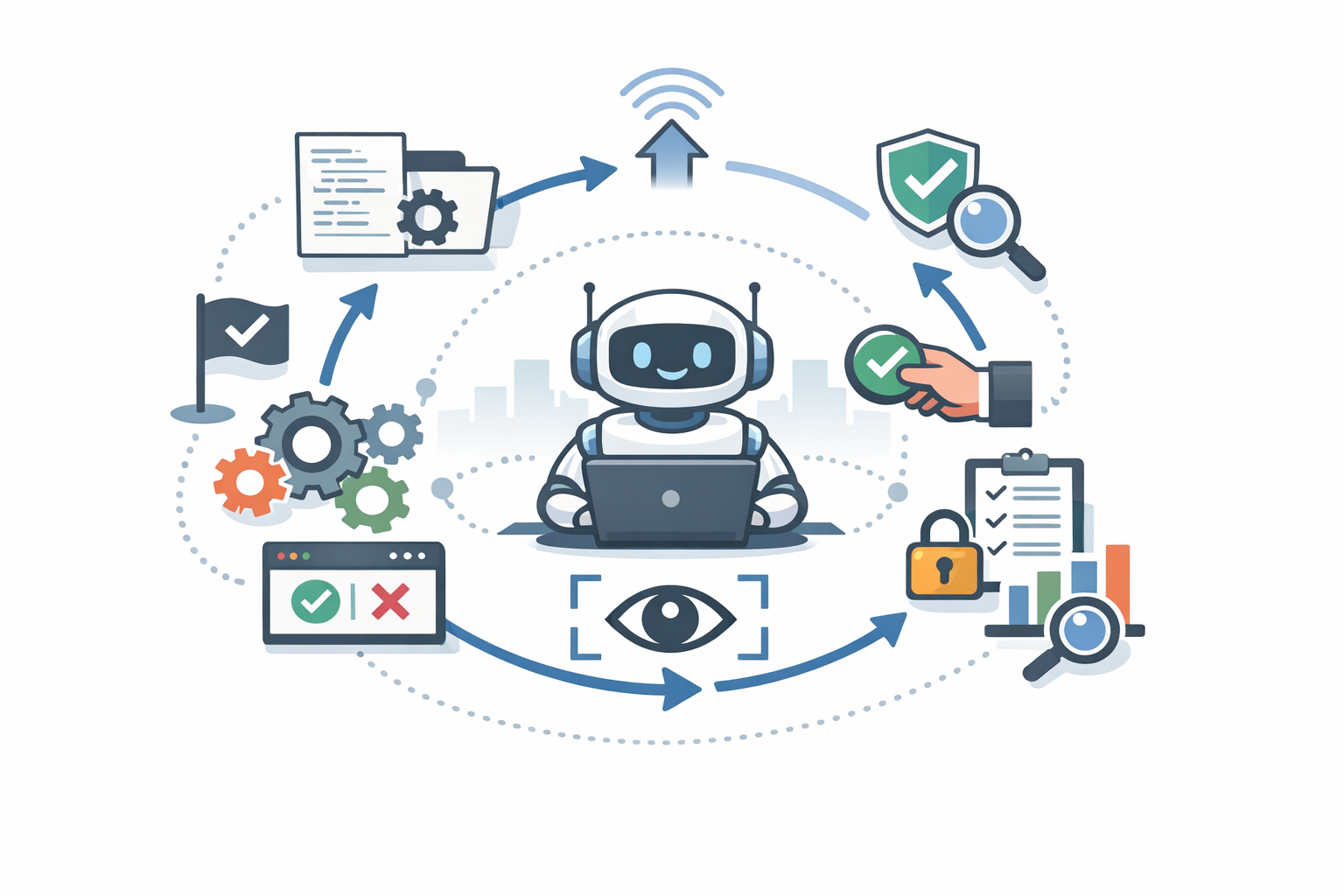
In this blog post Harness Engineering and the Rise of AI-First Software Delivery we will look at why a new discipline is emerging around AI coding agents, what the underlying technology actually does, and how leaders can adopt it without creating governance debt.
At a high level, harness engineering is the practice of building the working environment around an AI agent so it can deliver software safely, repeatedly, and with less supervision. It is not just prompting. It is the combination of context, tools, guardrails, test loops, approvals, and feedback that turns a powerful model into a usable delivery system.
In my experience, that distinction matters a lot. After 20+ years working across enterprise IT as a Solution Architect and Enterprise Architect, I have learned that speed is rarely the hardest problem. Controlled speed is the hard problem. AI can generate code quickly, but without a harness, it can also generate drift, risk, and technical debt at a speed most teams are not prepared for.
I am based in Melbourne and work with organisations across Australia and internationally. Whether the stack is Azure, Microsoft 365 automation, modern APIs, or AI platforms such as OpenAI and Claude, I keep seeing the same pattern. AI acts as an amplifier. Strong engineering systems get faster. Weak engineering systems get louder.
What harness engineering actually means
As a published author, I care about using precise language. Harness engineering is a useful term because it names the real work. The breakthrough is not that AI can write code. The breakthrough is that teams are learning how to structure an environment where AI can write the right code, test it, explain it, and stay within the boundaries the organisation cares about.
Think of it as the next layer on top of platform engineering. Platform engineering built paved roads for human developers. Harness engineering builds paved roads for both humans and agents.
A clear task and definition of done
Architecture context the agent can read
Access to approved tools such as Git, CI, test runners, and package managers
Automated feedback from build, lint, security, and runtime checks
Approval points for sensitive changes
Logging and traceability so humans can review what happened
Without those elements, an AI coding agent is really just an enthusiastic intern with root access. With them, it becomes a productive member of the delivery system.
The technology behind it
The main technology behind harness engineering is the agent loop. Most leaders first notice the model, but the model is only one part of the picture. The real value comes from how the model is wrapped inside a repeatable execution loop.
At a practical level, the loop usually looks something like this.
while task_not_done:
 understand_goal()
 read_repo_context()
 plan_change()
 edit_code()
 run_tests()
 run_security_checks()
 review_diff()
 repair_failures()
 prepare_pull_request()
That may look simple, but it changes the nature of software delivery. The agent is no longer guessing in a blank chat window. It is operating inside a structured workflow with state, tools, and feedback.
There are five technical building blocks that make this work.
1. Structured context
Agents perform far better when they can read the architecture, coding standards, dependency maps, naming conventions, and delivery rules of the environment they are working in. In Azure-heavy estates, that might include landing zone patterns, identity boundaries, approved infrastructure modules, and logging standards. In Microsoft 365 environments, it may include compliance boundaries, app registration rules, or automation runbook conventions.
One practical pattern I like is a simple instruction file in the repository that tells the agent how the team works. For example:
# Agent working agreement
Goal: Deliver small, reversible changes
Rules:
- Run tests before proposing changes
- Do not change identity or network policies without approval
- Use approved Azure modules only
- Update runbooks and README files when behaviour changes
Done when:
- Build passes
- Security checks pass
- Rollback path is documented
This sounds basic, but it is often the difference between useful automation and unpredictable output.
2. Tool use instead of text-only generation
The second building block is tool access. Modern coding agents are valuable because they can inspect files, run tests, query logs, compare diffs, and operate in controlled sandboxes. That matters because software delivery is not a writing task. It is an execution task.
In one recent anonymised program I reviewed, the agent could produce reasonable code from day one. The real problem was that it had no reliable way to validate assumptions against the build environment. Once the team connected it to tests, linting, package policies, and ephemeral environments, quality improved more than prompt quality ever had.
3. Feedback loops
Great human engineers rely on feedback. So do agents. A harness gives the model evidence about whether a change worked. Build failures, unit test results, security findings, runtime logs, and even cost signals can all become part of the loop.
This is why I see harness engineering as more operational than magical. The model proposes. The system responds. The agent adapts. That is far more robust than asking for a perfect answer in one shot.
4. Guardrails and policy
The fourth building block is control. Leaders should be careful here. If the harness is too open, the agent becomes risky. If it is too restrictive, the agent becomes expensive theatre.
Good harnesses enforce machine-readable rules. They do not rely on hope. That might mean branch protection, mandatory reviews on identity changes, secret scanning, dependency policies, environment allow-lists, and blocked access to production credentials.
5. Observability and auditability
The final building block is visibility. If an agent edits code, opens pull requests, runs commands, or touches deployment pipelines, those actions should be observable. Senior leaders do not need a science project. They need traceability, explainability, and confidence that the system can be governed.
Why this matters to CIOs and CTOs
One reason this discipline matters is that it reframes the AI discussion. The question is no longer whether developers can generate code faster. The question is whether the organisation can absorb more change safely.
That has business implications.
Throughput improves because routine changes, tests, refactors, and documentation can be handled in parallel.
Legacy modernisation becomes more realistic because agents can work through repetitive migration tasks that teams often postpone.
Key-person dependency reduces when architecture knowledge is written down in a form both humans and agents can use.
Governance can improve if controls are embedded in the harness instead of left to memory.
There is also a leadership shift here. In AI-first delivery, your best engineers spend less time typing every line and more time shaping system behaviour. They design standards, build feedback loops, decide where judgment is still required, and improve the environment that everybody else works in, including the agents.
Where organisations get it wrong
The most common mistake I see is treating harness engineering as a developer tooling purchase. It is not. It is an operating model change.
The second mistake is measuring success by generated lines of code. That is the wrong metric. I would rather see improvements in lead time, change failure rate, rollback effort, incident volume, and time spent on rework.
The third mistake is ignoring security and privacy until later. In the Australian context, that is not a minor detail. If prompts, logs, test data, or fine-tuning sets contain personal information, that becomes a governance issue very quickly. Public AI tools are not the right place for sensitive data, and internal teams need clarity on what can and cannot be used.
From a cyber perspective, the basics still matter. If your build runners, developer endpoints, and privileged paths are weak, AI will simply move those weaknesses faster. That is why I still anchor these conversations in fundamentals such as least privilege, MFA, patching discipline, secure backups, and the broader mindset behind the Essential Eight. AI does not replace cyber hygiene. It raises the cost of not having it.
A practical operating model for the first 90 days
If I were advising a leadership team on where to begin, I would keep it simple.
Choose a bounded use case. Start with internal tooling, documentation-heavy services, test generation, or low-risk maintenance work.
Make one repository AI-readable. Add architecture notes, conventions, definitions of done, and ownership boundaries.
Connect the feedback loop. Require tests, linting, security scanning, and clear pass or fail signals.
Define approval zones. Identity, networking, production data, and financial logic should not be treated the same as UI fixes.
Measure business outcomes. Look for reduced cycle time, better documentation, lower toil, and fewer routine tasks landing on scarce senior engineers.
In my hands-on work with Azure and AI platforms, I have found this approach far more effective than broad mandates. Start narrow. Learn quickly. Encode what works. Then scale.
My view on where this goes next
I do not think harness engineering is a passing phrase. I think it is an early name for a lasting shift. As agentic development becomes normal, every serious technology organisation will need a view on how agents are instructed, constrained, observed, and measured.
The organisations that benefit most will not be the ones making the loudest claims about AI-first delivery. They will be the ones quietly building better systems around it. Humans will still own architecture, risk, and judgment. But more of the implementation path will be delegated to agents that work inside a well-designed harness.
For leaders, that creates an interesting question. If AI is becoming a new layer in software delivery, are we investing enough in the environment around the model, or are we still focusing too much on the model itself?
- Anthropic’s DoD stance just changed what “safe” enterprise AI means
- About
- MCP A2A OpenTelemetry and OAuth Every Architect Must Track in 2026
- The Hidden Risk in Enterprise Agentic AI and Silent Failures
- OpenAI’s $110B Raise and What It Changes in Enterprise AI Roadmaps
