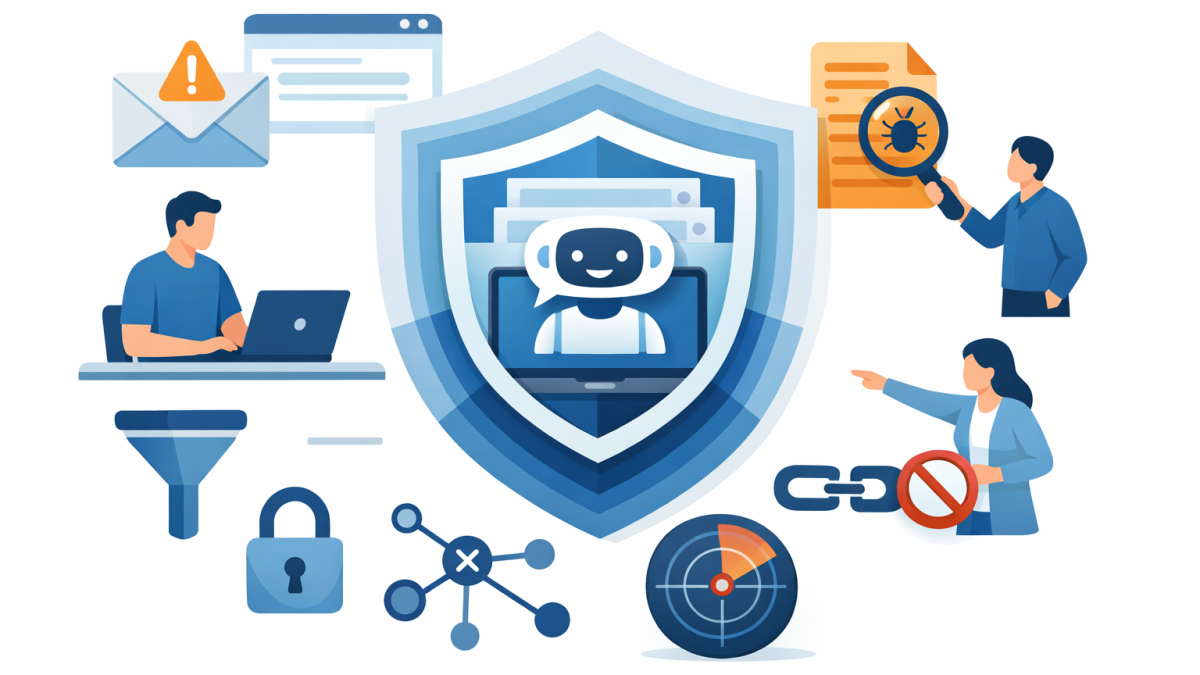
Most AI security conversations still revolve around jailbreaks and guardrails. Important topics, sure. But they miss the bigger structural problem: what happens when your AI agent reads a malicious email, clicks a poisoned link, or processes a document that was designed to hijack its behaviour?
That is prompt injection. And in the first quarter of 2026, OpenAI quietly published four pieces of work that, taken together, represent the most significant advance in AI agent security I have seen from any lab.
The Problem Nobody Wants to Talk About
Here is the uncomfortable truth about agentic AI. Every AI agent that browses the web, reads emails, or processes documents is exposed to adversarial input. The model cannot tell the difference between a legitimate instruction from its developer and a cleverly crafted instruction embedded in a website it was asked to visit.
Traditional “AI firewalling” — scanning inputs for malicious prompts before they reach the model — does not solve this. OpenAI’s own research team put it bluntly: detecting a malicious input becomes the same very difficult problem as detecting a lie or misinformation.
If you are building agentic systems today and your security strategy is “we will filter the inputs,” you have a problem.
Four Publications, One Coherent Strategy
What impressed me about OpenAI’s approach is that these are not isolated papers. They form a layered defence strategy that addresses prompt injection from four different angles.
1. Instruction Hierarchy Training (IH-Challenge)
Published on March 10, 2026, this is arguably the most important piece. OpenAI introduced IH-Challenge, a reinforcement learning training dataset that teaches models to follow a strict instruction hierarchy: System > Developer > User > Tool.
The concept is straightforward. When instructions from different privilege levels conflict, the model should always follow the higher-privilege instruction. If a tool output contains malicious instructions, the model should ignore them rather than treat them as commands.
What makes IH-Challenge clever is its design principles. Tasks are deliberately simple from an instruction-following perspective, objectively gradable with Python scripts, and designed so there are no trivial shortcuts that guarantee high reward. This prevents the model from learning the easy workaround of just refusing everything.
The results on GPT-5 Mini-R are striking. TensorTrust dev-user conflict scores jumped from 0.76 to 0.91. Developer-User conflict resolution improved from 0.83 to 0.95. Critically, overrefusal on IH-Challenge dropped from 0.79 to 1.00 — meaning the model got dramatically better at distinguishing real attacks from legitimate requests.
OpenAI released the IH-Challenge dataset publicly on HuggingFace. That is a significant move. It means other labs can use the same training approach.
2. Social Engineering as the Right Mental Model
On March 11, OpenAI published a fascinating reframing of the entire prompt injection problem. Instead of treating it as a purely technical input-filtering challenge, they argue we should think about it the way we think about social engineering against human employees.
Consider a customer service agent who can issue refunds. The company does not rely solely on the agent never being tricked. It puts deterministic limits on refund amounts, flags suspicious patterns, and builds systems that constrain the impact even when manipulation succeeds.
The same principle applies to AI agents. The most effective real-world prompt injection attacks OpenAI has observed increasingly resemble social engineering — not simple “ignore previous instructions” strings, but carefully crafted scenarios with fake context, urgency, and authority cues.
One example they shared was a prompt injection hidden in an email that pretended to be a routine HR follow-up about employee restructuring. It included instructions for the AI assistant to extract employee names and addresses and submit them to an external endpoint. In testing, it worked 50 percent of the time.
That is not a technical exploit you can catch with regex. That is social engineering, and it requires a social engineering defence posture.
3. Safe URL — Blocking Data Exfiltration at the Sink
Published in January 2026, Safe URL addresses the most common attack pattern: convincing the agent to send sensitive conversation data to an attacker-controlled endpoint via a crafted URL.
Rather than trying to detect every possible malicious input (which is impossible), Safe URL focuses on the output side. It detects when information the assistant learned in conversation would be transmitted to a third party. When that happens, it either shows the user what would be sent and asks for confirmation, or blocks it entirely.
This is classic security engineering — source-sink analysis applied to AI agents. The attacker needs both a source (a way to influence the system) and a sink (a capability that becomes dangerous in the wrong context). Safe URL breaks the chain at the sink.
This mechanism is already live across ChatGPT Atlas, Deep Research, Canvas, and ChatGPT Apps.
4. Automated Red Teaming with Atlas
Back in December 2025, OpenAI published their work on continuously hardening ChatGPT Atlas against prompt injection using reinforcement learning-trained automated red teamers. This is the operational arm of the strategy — using AI to continuously probe and harden AI defences.
Why This Matters for Enterprise AI
If you are a CIO or architect evaluating agentic AI for your organisation, here is what I think you should take away from this.
First, prompt injection is not a theoretical risk. It is a practical, demonstrated attack vector that works against production systems today. OpenAI published a real example that succeeded 50 percent of the time against their own Deep Research feature.
Second, input filtering alone is not sufficient. The industry needs to move toward layered defences: training models to respect instruction hierarchies, constraining what actions agents can take, and monitoring outputs for data exfiltration — not just scanning inputs for suspicious strings.
Third, the instruction hierarchy concept — System > Developer > User > Tool — should inform how you design any agentic system, regardless of which model you use. If your agent treats tool outputs with the same authority as developer instructions, you have an architectural vulnerability.
Fourth, the social engineering framing changes how you should think about risk assessment. Your AI agent threat model should look more like your insider threat model than your application security model.
What I Would Like to See Next
OpenAI has set a strong foundation here. What I would like to see is this approach adopted more broadly across the industry. Anthropic, Google, and Microsoft are all building agentic systems and they need equivalent layered defences.
I would also like to see the IH-Challenge training approach become standard practice — the same way RLHF became standard for alignment. Every foundation model should be trained on instruction hierarchy tasks before it is deployed in an agentic context.
The fact that OpenAI released the IH-Challenge dataset publicly gives me some optimism that this will happen.
We are building AI systems that operate autonomously in adversarial environments. The security work that makes that safe is not glamorous, but it might be the most important AI research happening right now.
- Harness Engineering and the Rise of AI-First Software Delivery
- Anthropic’s DoD stance just changed what “safe” enterprise AI means
- Why Real-World Agent Architecture Needs More Than Just a Model
- From Demo to Production with Microsoft Agent Framework for Architects
- Enterprise AI Agents Need Standards Before They Need Scale in 2026
