I do not think the important story about Claude Fable 5 is only the model itself.
The more interesting story is what happens when a model like this lands inside Microsoft Foundry.
For years, enterprise AI platforms have talked about model choice. In practice, that choice has often felt narrow. One preferred model. One default provider. One procurement path. One set of integration assumptions. The enterprise got a button called “choice”, but the platform still behaved like a single-model product.
Claude Fable 5 changes that conversation for me.
Not because every enterprise will standardise on it.
Because its presence makes Microsoft Foundry look less like a wrapper around a few approved models and more like a serious model broker.
Why Claude Fable 5 matters
The value of a frontier model is not just benchmark performance. I care more about how it behaves inside real enterprise work.
That means:
- Can it handle long, messy context without losing the thread?
- Can it reason through multi-step tasks without turning every answer into theatre?
- Can it write, review, and explain code with enough discipline to be useful?
- Can it follow enterprise instructions, not just prompt tricks?
- Can it work across documents, tools, and workflows without becoming unpredictable?
- Can governance teams understand where it fits and where it should not be used?
Claude models have usually been strong in the areas enterprises actually notice after the demo: writing quality, instruction following, careful reasoning, and coding assistance. If Claude Fable 5 extends those strengths into longer-running agentic work, then it becomes more than another model in a catalogue.
It becomes a serious option for work where tone, context, safety, and judgement matter.
That includes architecture reviews, code migration, document analysis, policy interpretation, customer support workflows, internal research, and assisted engineering tasks.
The point is not that Claude Fable 5 will be the best model for every job. No model is.
The point is that it is credible enough to force model selection to become an architectural decision instead of a vendor preference.
Foundry becomes interesting when the model is not the centre
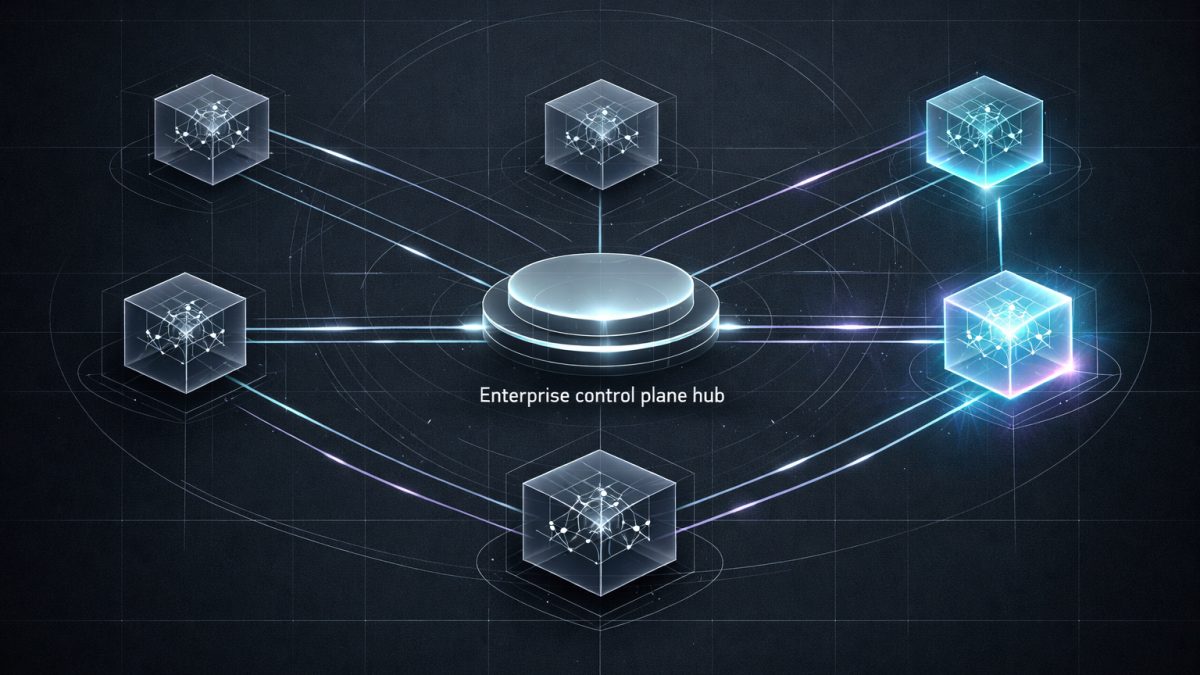
Microsoft Foundry is most useful when I stop thinking about it as a place to “try models” and start thinking about it as a control plane.
A real enterprise model broker needs to do more than list model names.
It needs to help teams answer practical questions:
- Which model should this workload use?
- What does it cost under real traffic?
- What latency should I expect?
- Which region, identity, network, and data controls apply?
- How do I evaluate one model against another using my own examples?
- How do I monitor quality after deployment?
- How do I switch models without rebuilding the whole application?
- How do I keep procurement, security, architecture, and engineering aligned?
This is where Foundry has a real opening.
If Microsoft can make Claude Fable 5 available next to OpenAI, small language models, open models, specialised models, and industry models, the catalogue stops being cosmetic. It becomes a marketplace with operational consequences.
That is the broker role.
Not “here are many models”.
More like: “here is a governed way to discover, compare, deploy, monitor, and replace models without turning every AI project into a one-off integration”.
The broker pattern is different from the cloud-hosted model pattern
A hosted model endpoint is simple. You call it. It responds. You pay for usage.
That is useful, but it is not enough for enterprise AI adoption.
A broker pattern is different. It accepts that the enterprise will use multiple models for multiple tasks.
One model may be better for code review. Another may be better for summarisation. Another may be better for low-cost classification. Another may be better for multimodal reasoning. Another may be approved only for internal data. Another may be allowed only for public content.
In that world, the platform needs to manage variation.
Variation in model capability.
Variation in cost.
Variation in risk.
Variation in compliance requirements.
Variation in team maturity.
Claude Fable 5 makes this more visible because it is the kind of model teams will want to evaluate seriously. It is not a checkbox partner model that sits in the catalogue for marketing value. It is the sort of model that developers, architects, and business teams may actually ask to use.
That demand pressures Foundry to behave like infrastructure, not a gallery.
What I would test first
If I were evaluating Claude Fable 5 in Foundry, I would not start with generic prompts.
I would build a small evaluation pack from real work.
For example:
- A legacy code file that needs refactoring advice
- A design document with conflicting requirements
- A security policy that needs practical interpretation
- A support transcript that needs classification and next steps
- A data extraction task from a messy business document
- A migration plan that needs risks, dependencies, and sequencing
- A multi-turn agent task where the model must keep state and not overreach
Then I would run the same pack across multiple models.
I would look for boring things:
- Does the model ask for clarification when it should?
- Does it invent missing facts?
- Does it preserve constraints across turns?
- Does it produce output the team can actually use?
- Does it handle edge cases consistently?
- Does the answer quality justify the cost?
- Does latency make the workflow painful?
- Does the model fail safely?
This is where a model broker earns trust.
The enterprise does not need another leaderboard. It needs repeatable evaluation against its own work.
Enterprise adoption needs optionality
The biggest mistake I see in enterprise AI strategy is treating model choice as a permanent decision.
It is not.
Models are moving too quickly. Pricing changes. Context windows change. safety behaviour changes. Tool use changes. Coding ability changes. Regional availability changes. Provider strategy changes.
If an organisation hard-codes its AI roadmap around one model, it creates a future migration problem.
If it builds around a broker layer, it has options.
That does not mean every application should dynamically switch models every hour. That sounds clever and usually becomes operational noise.
But it does mean teams should design for controlled substitution.
A good enterprise AI platform should make it possible to say:
- This workload uses Claude Fable 5 because it handles long-form reasoning well.
- This high-volume task uses a smaller model because cost matters more than nuance.
- This regulated workflow uses only models approved for that data class.
- This engineering assistant can be tested against a new model before production use.
- This agent can be rolled back if behaviour changes.
That is the kind of discipline that moves AI from experiments to systems.
Foundry’s advantage is not only the models
Microsoft’s advantage is the surrounding enterprise fabric.
Identity matters.
Networking matters.
Logging matters.
Cost management matters.
Data governance matters.
Developer workflow matters.
Procurement matters.
Most AI demos ignore those things because they are not exciting. In the enterprise, they are the adoption path.
If Foundry can combine model diversity with Azure-style controls, then it has a strong position. Not because it owns every best model, but because it can make multiple models usable inside existing enterprise boundaries.
That is why Claude Fable 5 matters strategically.
It gives Foundry a chance to prove that third-party frontier models can feel first-class inside the Microsoft ecosystem.
If that works, Foundry becomes less about Microsoft choosing the winning model and more about Microsoft brokering access to the models enterprises need.
The risk is abstraction without accountability
There is a trap here.
A model broker can become too abstract.
If the platform hides too much, teams may stop understanding the model they are using. That is dangerous.
Different models have different behaviours, training histories, safety approaches, context handling, tool-use patterns, and failure modes. Treating them as interchangeable text engines is lazy architecture.
A serious broker should not erase those differences. It should expose them in useful ways.
I want to see:
- Clear model cards
- Practical safety notes
- Region and data handling information
- Pricing visibility
- Evaluation tooling
- Version controls
- Deprecation notices
- Monitoring hooks
- Policy-based deployment controls
- Evidence that model changes can be tested before they affect users
Without that, “model marketplace” becomes a nicer UI for unmanaged risk.
With it, the marketplace becomes a governance layer.
What this means for AI architects
For AI architects, Claude Fable 5 in Foundry is a signal to think in layers.
The application should not know too much about the provider.
The orchestration layer should understand task routing, prompts, tools, memory, retrieval, and evaluation.
The governance layer should understand policy, logging, approvals, and risk.
The model layer should be replaceable, but not anonymous.
That balance matters.
Too much abstraction and you lose model-specific quality.
Too little abstraction and every application becomes locked to one provider.
The broker pattern sits in the middle.
What this means for CIOs and IT leaders
For CIOs, this is about reducing strategic dependency.
Enterprise AI adoption is no longer just a question of whether a model is impressive. It is a question of whether the organisation can adopt AI without creating a new form of platform lock-in.
A model broker gives leaders a better operating model:
- Standardise governance without standardising on one model forever
- Compare providers using internal evidence
- Match model cost to business value
- Keep sensitive workloads inside approved controls
- Let engineering teams experiment without bypassing enterprise policy
- Avoid rebuilding applications when the model landscape changes
That is a more mature conversation than “which chatbot should we buy?”
My view
I see Claude Fable 5 as a forcing function.
If it is strong enough to become a serious enterprise option inside Foundry, then Microsoft has to make the broker experience real. Discovery is not enough. Deployment is not enough. The platform has to support evaluation, governance, routing, observability, and replacement.
That is where enterprise AI is heading.
Not one model.
Not one provider.
Not one magic assistant.
A portfolio of models, selected and governed with intent.
Claude Fable 5 may be the model that makes more teams notice that Microsoft Foundry is no longer just a model catalogue. It could become the place where enterprise model strategy is actually executed.
The question I keep coming back to is simple: will enterprises use Foundry to pick a model, or will they use it to build the discipline of changing models safely?
