On 17 April, Anthropic quietly dropped something that changes how I think about the design stack.
Claude Design landed as the second product out of Anthropic Labs, and it lets you generate polished designs, prototypes, slide decks, one-pagers and marketing collateral through a conversation with Claude. It’s powered by Opus 4.7, their most capable vision model, and it’s available right now to Pro, Max, Team, and Enterprise subscribers.
This is not a “designer helper” feature bolted onto a chat window. It’s a full design surface with a brand system, inline editing, sliders, web capture, and export to Canva, PPTX, PDF, or HTML. That’s a product.
What Claude Design actually is
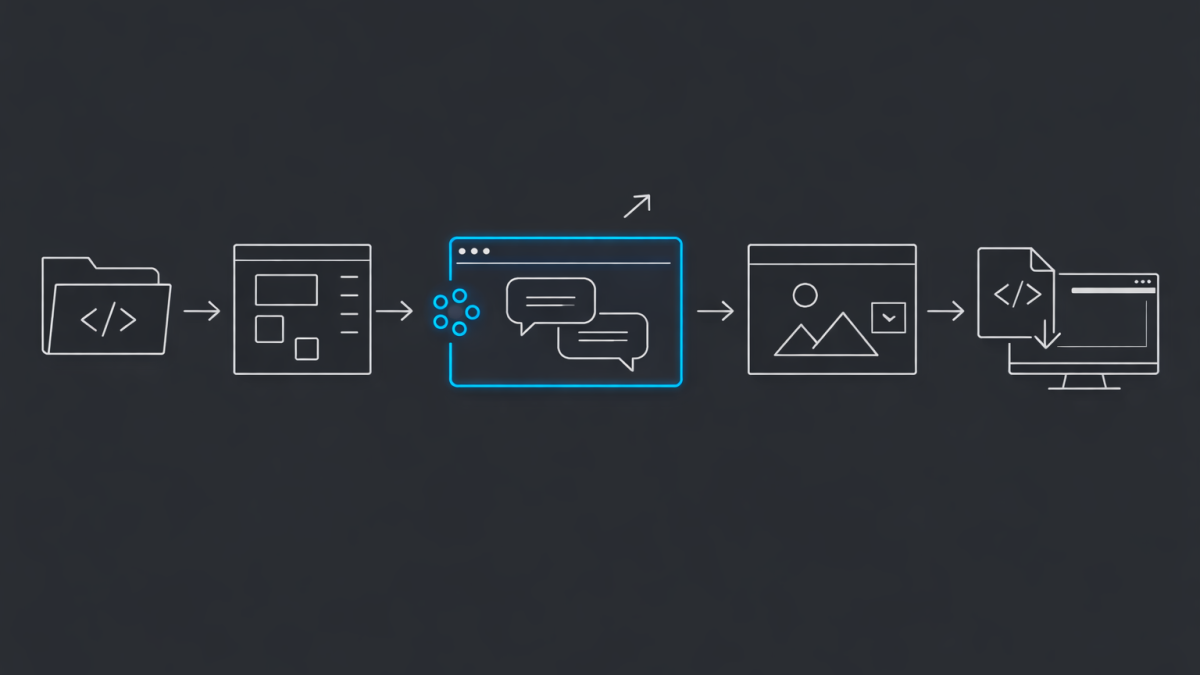
You describe what you want. Claude builds a first version. From there, you refine through conversation, inline comments on specific elements, direct text edits, or custom sliders that Claude generates on the fly for spacing, colour, or layout.
The piece I keep coming back to is brand ingestion. During onboarding, Claude reads your codebase and design files and builds a design system for your organisation. Every project after that uses your colours, typography, and components automatically. Teams can maintain more than one design system.
That is the part that should make Figma and Canva nervous. The friction in both tools is not the canvas. It’s getting your brand set up, keeping it consistent, and handing work off to developers.
The handoff story is the real story
When a design is ready to build, Claude Design packages the whole thing into a handoff bundle for Claude Code. One instruction, and the prototype moves toward production.
For anyone who has lived through the Figma-to-Jira-to-frontend-engineer relay, this is a different shape of workflow. The design artefact and the code artefact are converging in the same tool, produced by the same model family, with design intent preserved end-to-end.
Datadog’s product manager said in the launch post that what used to take a week of briefs, mockups, and review rounds now happens in a single conversation. Brilliant said pages that needed 20+ prompts in other tools took 2 prompts in Claude Design. Those are not marketing numbers I would normally quote, but they match what I have been seeing from teams experimenting with AI design tools over the last six months.
Why this is a direct shot at Figma and Canva
Figma owns professional product design. Canva owns marketing and non-designer visual work. Claude Design is coming for both at once.
For Figma, the threat is the prototype-to-code handoff. Figma’s answer has been Dev Mode and their own Figma Make AI product. Claude Design flips the direction: start with AI, export to code through Claude Code, and treat the visual artefact as a by-product of the conversation.
For Canva, the threat is more subtle. Canva’s CEO Melanie Perkins is in the launch post as a partner, with a direct export from Claude Design into Canva. Read that carefully. The flow Anthropic is describing is “generate in Claude, polish in Canva.” Canva becomes the downstream editor, not the starting point. That is a significant repositioning for a company whose entire pitch is that Canva is where design begins for non-designers.
The architectural question
What Claude Design really proves is that Anthropic is done being a model provider. They are building vertical applications on top of their own models, in categories where the incumbents have spent a decade building moats.
Claude for Excel. Claude for PowerPoint. Claude for Word. Claude Code. Claude Cowork. Claude Design. Anthropic Labs as the R&D pipeline. A $100 million Partner Network. A Sydney office opening in Asia-Pacific.
This is a platform company now, not just a frontier lab. And the platform is being built around the idea that conversation is the primary interface for knowledge work, and specialist apps like Figma, Canva, Office, and traditional IDEs are all legacy surfaces that will get abstracted away.
I am not convinced they will win every category. Figma’s design fidelity and collaboration depth are real. Canva’s scale and marketplace are real. But Anthropic does not need to win outright. They need to make Claude the default first draft for design work, the same way ChatGPT became the default first draft for writing. Once that habit forms, the downstream tools become commodity polishers.
What I would watch next
Three things.
First, how fast enterprises actually enable Claude Design. It is off by default for Enterprise plans, admins have to turn it on. That switch is where IT, security, and design leadership have to agree, and it is a real friction point.
Second, how Figma and Canva respond in the next two quarters. Figma Make was already their AI answer. Expect an aggressive feature push. Canva has the advantage of being the partner, not the competitor, for now.
Third, whether Claude Design produces work that is actually good enough for senior designers, or just good enough for founders, PMs, and marketers who were never going to open Figma anyway. Those are two very different markets, and the pricing and positioning implications are enormous.
For now, I am booking time this week to build a real prototype in Claude Design and see how the handoff to Claude Code feels. That is the test. If the full loop from idea to working prototype to production-ready frontend holds up, we are looking at a genuinely new category, not just a Figma competitor.
